
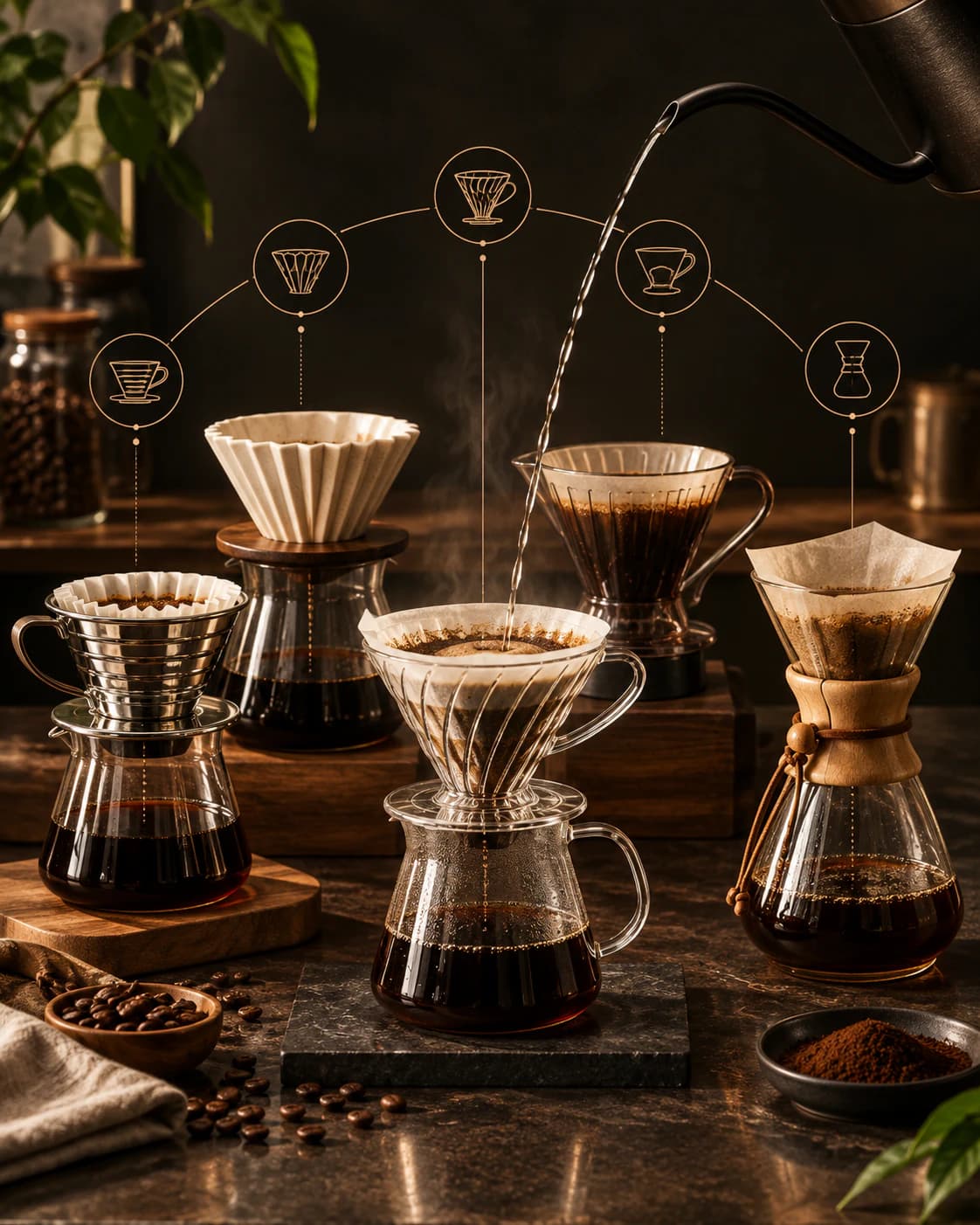
Not every filter works in the same way
V60, Chemex, Kalita, Origami and Clever all use coffee, water and some form of filter, but they organise contact differently. Geometry, number of openings, material, paper thickness and pouring technique alter flow, temperature and agitation. No brewer is forced to produce one kind of cup, although each design encourages particular behaviours.
Instead of asking which is best, it is more useful to consider how much control we want, which texture we enjoy and how much time we wish to spend repeating a technique.
Kalita Wave and a flat bed
The Kalita Wave uses a flat base, several openings and a waved filter that reduces contact with the brewer walls. Its shallower coffee bed can support even extraction and a stable preparation, although grind size and pouring still matter.
It is a useful choice for someone seeking clarity with a relatively forgiving technique. Pulsed pours can control the water level without necessarily demanding one extremely precise continuous stream.
Origami and the freedom to choose
The Origami is a ribbed cone that can accept different filter styles depending on the holder. This flexibility makes it possible to explore different flows and profiles with one brewer. A cone-shaped paper can support a faster pour-over approach, while a flat-bottom filter changes bed geometry and recipe response.
Freedom also makes organised testing important. Choose a filter and recipe first, keep them stable and adjust grind size before changing several pieces at once.
Clever: immersion meets filtration
The Clever Dripper uses a valve to hold coffee and water together during immersion, then releases the drink when placed on a cup. It reduces the importance of pouring precision and combines a straightforward process with the clean texture of a paper filter.
It is especially useful for learning because contact time and draining are easy to separate. We can then return to V60, Chemex or another brewer with a clearer idea of what changes when water flows from the beginning. The collection does not end here: each brewer is another way to view the same coffee.