
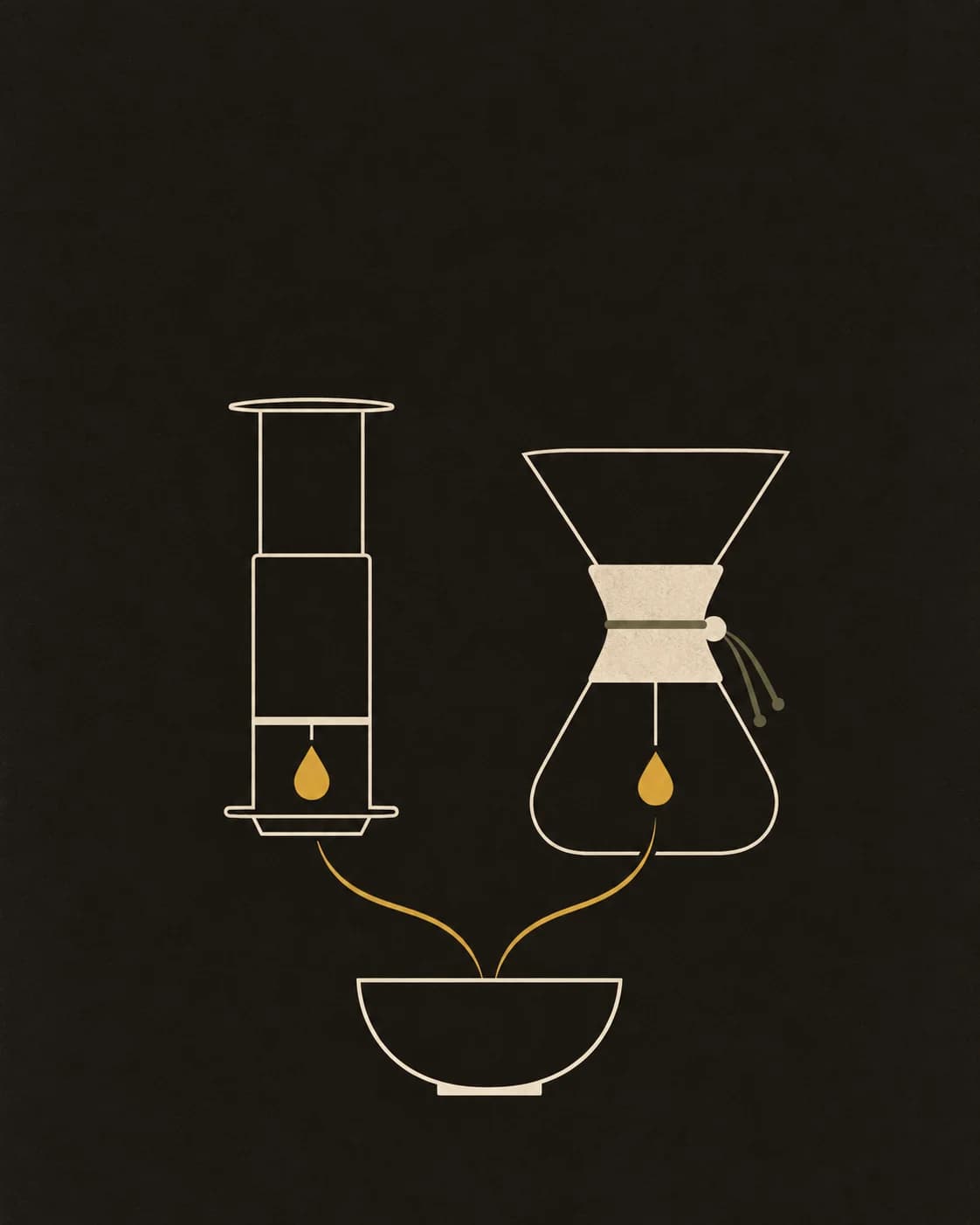
The main difference: immersion or pour-over
In an AeroPress, coffee and water sit together in a chamber before the plunger pushes the drink through a filter. A Chemex works by gravity: you pour water over the grounds and it travels through the coffee bed and paper into the carafe. One combines immersion and manual pressure; the other uses percolation.
With an AeroPress, you can focus on how long the coffee stays in contact with the water. With a Chemex, the way you distribute your pour also matters. Both invite experimentation, but with different movements. Here we compare an AeroPress Original with a glass Chemex using paper filters; other sizes and accessories can change the experience.
Flavour and body: which makes better coffee?
Chemex often produces a clean, light texture: its filter retains oils and fine particles. This can make a coffee's nuances easier to notice without much sediment. An AeroPress with paper can also make a clean cup, while the recipe and filter offer room to vary concentration and texture.
Those tendencies are not fixed rules: Chemex does not mean watery coffee, and AeroPress does not automatically mean strong coffee. Compare them using the same beans and a similar coffee-to-water ratio. Taste once the drinks have cooled a little, noticing sweetness, texture and finish. The better cup is the one you want to make again.
One cup for yourself or a carafe to share
An AeroPress Original is practical for an individual cup. For several people drinking together, a suitably sized Chemex avoids brewing repeatedly. Larger AeroPress models also exist, so compare the capacity of the specific brewer rather than the brand name alone.
A manufacturer's cup is not necessarily the same size as your breakfast mug. Think in millilitres and consider how many people you serve. A carafe that looks large in a photograph may be too small if everyone uses generous mugs.
Time, cleaning and coffee away from home
For work or travel, we would choose the AeroPress Original for its compact format. For an unhurried table at home, Chemex offers a different advantage: you brew and serve in the same carafe. Glass needs more care during transport.
When comparing time, include heating water, grinding, brewing and cleaning. With AeroPress, you can eject the coffee puck and rinse the parts; with Chemex, remove the filter and clean the carafe. A quick recipe loses some appeal if the rest feels awkward in your kitchen. The best everyday brewer is often the one you enjoy using repeatedly.
Grind and accessories: where to start
As an initial guide, try a medium-fine grind for AeroPress and a medium-coarse grind for Chemex, then adjust to your recipe. Do not copy settings from a different grinder: their scales are not equivalent. If water barely passes through the grounds or pressing requires excessive force, review your grind and the manufacturer's instructions.
Scales and a grinder with repeatable settings help with both methods. A gooseneck kettle makes the Chemex pour easier to control, although you do not need every accessory to begin. Check that compatible filters are easy to find: their cost and availability belong in the decision too.
Our choice for different routines
We would choose AeroPress Original for someone making one cup, with limited space and a need for portability. We would choose Chemex for someone who enjoys pouring and wants a carafe in the middle of the table. If you already own either, learning to adjust your recipe may give you more than buying another brewer.
At Baristas Club, understanding coffee is a way to enjoy it. When you visit Tendería 30 in Bilbao's Old Town, tell us how you brew at home and which flavours you like. That is a useful starting point for a conversation about coffee, without needing technical vocabulary.
Frequently asked questions about AeroPress and Chemex
Does AeroPress make espresso? It can make concentrated coffee, but it does not reproduce an espresso machine's extraction. If you want that particular texture and preparation, do not treat the two as interchangeable.
Which is easier for a beginner? For an individual cup, we would start with a simple AeroPress recipe. If you enjoy taking your time and following the pour, you can learn with Chemex straight away. Repeating a recipe and changing one variable at a time helps more than looking for an infallible brewer.
Can I use the same beans in both? Yes. Adjust the grind and recipe for each brewer. You do not need a different origin for every coffee maker: using the same beans in both is an interesting way to discover what brewing changes.