
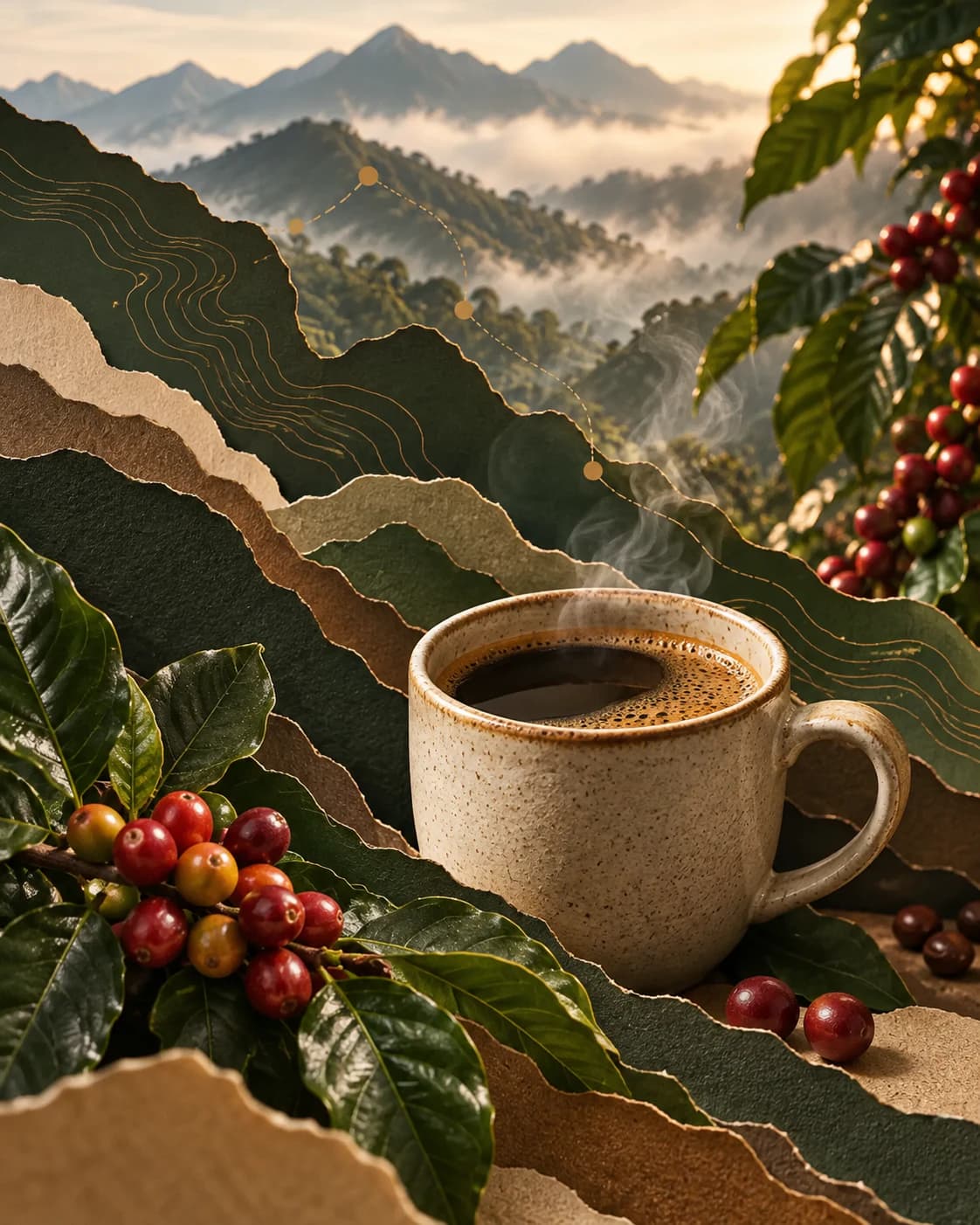
What origin really tells us
When a bag names a country, region or farm, it is not promising one automatic flavour. Origin brings together climate, soil, landscape, planted varieties, farming, harvesting and processing. Two coffees from the same country can be very different, while distant origins may share characteristics. Provenance gives us context; the cup completes the story.
The more precise the traceability, the better our questions become: who produced the coffee, in which area, from which variety and process, and under what conditions? This information does not replace flavour, but it helps us understand it and recognise the work that happened before roasting.
Why altitude is discussed
In many regions, higher altitude is associated with lower average temperatures and slower cherry maturation. That pace can favour dense seeds with interesting potential for roasting. The number alone never guarantees quality: latitude, orientation, shade, rainfall, variety and farm management all change what growing at a given elevation means.
Fifteen hundred metres near the equator is not identical to the same elevation at another latitude. Agronomic variety catalogues therefore relate optimal altitude to location rather than drawing a universal line between good and bad coffee.
Influence on cup profile
As a broad tendency, some high-grown coffees can show defined acidity, floral or fruit aromas and complex structure. Warmer regions can also produce sweet, balanced and excellent coffees. Altitude changes growing conditions; it does not write a tasting-note list by itself.
Variety, cherry ripeness, processing, drying, storage and roasting can reveal or hide that potential. Reading origin as a set of relationships keeps it from becoming an oversimplified label.
Using the information when choosing coffee
Origin and altitude work best as clues for comparison, never as a verdict. Tasting two regions from one country, or one variety grown in different places, teaches us more than memorising that a particular elevation must create a particular flavour.
A good label begins a conversation: it offers traceability, recognises producers and lets us return to a coffee we enjoyed. Then we brew, taste and discover how that place is expressed in this particular cup. Comparing harvests over time also shows that origin is alive rather than a flavour formula.